
In der Verbindungsindustrie, Das Biegen langer Schrauben nach der Wärmebehandlung ist ein allgemeines Problem. Traditionell “manuelles Hämmern” ist nicht nur ineffizient, sondern gewährleistet auch keine gleichbleibende Präzision. Dieser Artikel teilt eine spezielle Automatisierte Lösung zum Richten von Schrauben: demonstrating a reported client case in which automation took an 8-person manual line to one operator supervising four machines, with straightness held within 0.1 mm on the client’s acceptance records.
What is the Bolt?
Schrauben sind grundlegende Befestigungselemente für die Maschine, Konstruktion, und Automobilindustrie. Das typische Werkstück für diese Lösung ist eine hochfeste Langschraube: 15mm Durchmesser, 340mm Länge.
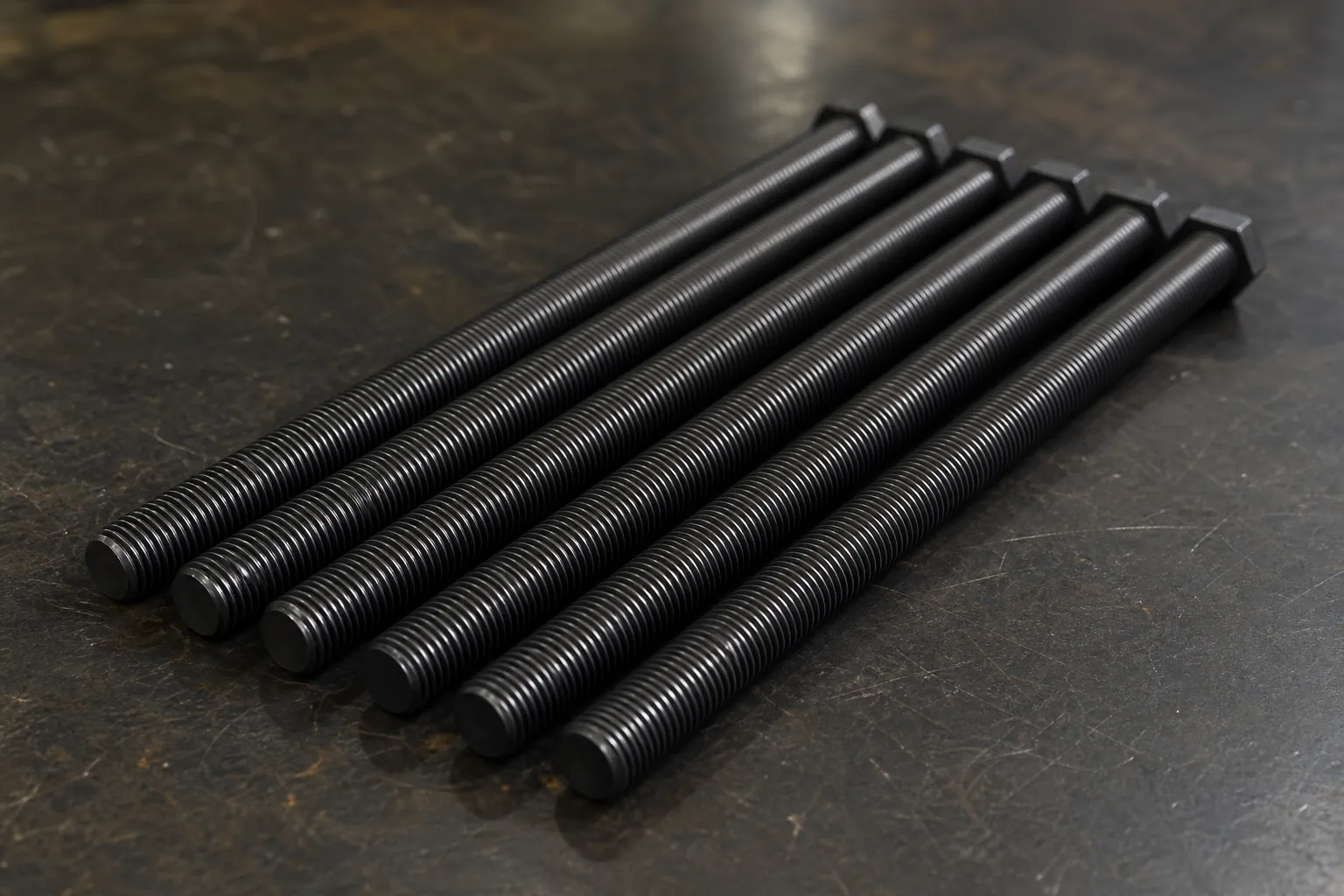
Strukturelle Merkmale und Herausforderungen
- Hohes L/D-Verhältnis: Aufgrund der Länge von 340 mm ist der Bolzen sehr anfällig für eine anfängliche Biegung von 0,5 mm – 1.5mm nach der Wärmebehandlung.
- Präzisionsanforderungen: The client required straightness within 0.2 mm; the case acceptance records were held under 0.1 mm.
- Schutzanforderungen: Der Richtprozess muss sicherstellen, dass die Gewindegenauigkeit und Oberflächenqualität nicht beeinträchtigt wird.
Why Heat Treatment Bends Long Bolts in the First Place
Understanding the distortion source is what makes a correction process defensible instead of decorative. During quenching, a long fastener cools unevenly: the section cools at different rates depending on orientation in the basket or fixture, agitation contact, and local mass differences between the plain shank, the threaded length and the head. Each cooling path wants to contract by a different amount, and the resulting locked-in stresses bend the part when it relaxes. The effect scales with length — which is why short bolts leave heat treatment usable while long ones of the same grade systematically arrive bent. Thread rolling and machining before treatment add their own stress history, and any straightening performed at the heat treater counts as prior deformation for everything done afterward.
Two practical consequences follow. Erste, incoming inspection on long heat-treated bolts is not optional paperwork — the bend magnitude and pattern arriving at the straightening station determine both the correction plan and any supplier conversation, and the interaction of prior deformation with correction response is the reason reverse-loading behavior matters, as covered under Der Bauschinger-Effekt beim Richten. Zweite, process decisions upstream — how parts are racked or basketed through quench, whether stress relief is applied — change the distribution the straightening station sees, and are usually the cheapest place to reduce total correction work.
Reading the Bend Before Correcting It
Long fasteners arrive with a small vocabulary of bend patterns, and naming the pattern is the first step of an efficient correction loop. A single-arc bow — one gentle curve, maximum near the middle — is the most common heat-treatment signature and the most straightforward to correct with supports positioned around the peak. An S-shaped double bend has two opposite peaks, usually reflecting two constraint points during quench, and demands two coordinated corrections rather than one big press at the largest reading. A local kink near the head or the thread runout concentrates distortion where section stiffness changes, and behaves differently from a distributed bow. Endlich, twist about the axis occasionally accompanies bending on parts with asymmetric features. Each pattern requires its own measurement map and correction sequence, which is why an automatic station that scans the full length and builds the map before pressing — rather than chasing the single worst reading — converges in fewer strokes. The measuring-and-correcting loop behind this is described for automatic shaft straightening generally, and for the long-bolt family specifically in the Automatischer Langbolzenrichtprozess.
Warum man sich vom Schraubenrichten abwenden muss “Manuelles Hämmern”
Traditioneller Prozess vs. Automatisierte Lösung
The figures below are this client’s reported baseline and post-commissioning values, not a universal benchmark for every fastener line.
| Schmerzpunkt | Manuelles Hämmern / Manuelles Drücken | Automatisierte Richtlösung |
| Arbeitsbedarf | 8 workers per shift (manual baseline, reported case) | 1 Betreiber für 4 Maschinen (reported case) |
| Geradlinigkeit | 0.2 – 0.5 mm spread (reported manual baseline) | ≤ 0,1 mm (client acceptance records) |
| Zykluszeit | 120 – 180 s/Stück (reported manual baseline) | 10 – 15 s/Stück (reported case) |
| Gesamtkosten | High labor cost per corrected part | Manpower reduced from 8 operators to 1 supervising 4 Maschinen (reported case) |
Automatisierter Prozessablauf zum Richten von Schrauben
Diese Lösung deckt einen vollständig geschlossenen automatisierten Prozess von der Zuführung bis zur Sortierung ab, Wir stellen sicher, dass jede Schraube die hohen Lieferanforderungen erfüllt.
Kernprozessbeschreibungen
- Automatische Fütterung: Gebogene Bolzen werden ohne menschliches Eingreifen automatisch aus einem Trichter der Richtstation zugeführt.
- Dynamische Messung: Hochpräzise Sensoren scannen das rotierende Werkstück in Echtzeit, genaue Erfassung des maximalen Biegepunktes über die gesamte Länge.
- Servopressung: Das intelligente System berechnet automatisch die Rückfederung basierend auf dem Material (Kohlenstoffstahl/legierter Stahl), und der Servostößel übt präzisen Druck für eine Korrektur in einem Durchgang aus.
- Automatische Sortierung: Qualifizierte Bolzen gehen zur nächsten Stufe über, while non-conforming parts are automatically isolated before they leave the machine.

UBJ-80 Bolzenrichtmaschine
Dieses Richtgerät ist ideal für wärmebehandelte Fertigteile (z.B., Stanz-/Büromaschinenkomponenten, Auto-/Motorradteile, Werkzeuge, Schrauben) und Bars (Stahl, Kupfer, Aluminium, Edelstahl, Titanlegierung) von 60–600 mm Länge & φ3–φ25 mm Durchmesser. Es steigert sowohl die Präzision als auch die Produktqualität.
Herausforderungen und Lösungen beim Kernrichten
Herausforderung 1: Manning and the Reported “1 Betreiber für 4 Maschinen” Case
Problembeschreibung: Manual hammering and press correction depend on operator skill, stamina and shift discipline, so manning levels stay high and results vary from operator to operator.
Lösung:
Unsere Lösung implementiert vollständige Automatisierung im geschlossenen Regelkreis. Die Bedienlogik ist äußerst einfach, mit integrierten Rezepten für verschiedene Schraubenspezifikationen. Ein normaler Arbeiter muss den Trichter nur regelmäßig nachfüllen; der Rest – Messung, Richten, und Inspektion – erfolgt automatisch durch die Maschine. Dies löst Arbeitskräftemangel und eliminiert ermüdungsbedingte Präzisionseinbußen.
Herausforderung 2: Garantierte Konsistenz mit einer Genauigkeit von 0,1 mm
Problembeschreibung: Wenn ein Bolzen Hammerschlägen ausgesetzt wird, Die innere Spannungsverteilung wird ungleichmäßig, Dies führt häufig zu einer Überkorrektur in lokalen Bereichen.
Lösung:
Die Lösung nutzt a voll parametriertes Servosteuerungssystem. Im Gegensatz zu vagen menschlichen Urteilen, Sensoren erfassen die axiale Krümmung der Schraube mit einer Genauigkeit im Mikrometerbereich. Durch mehrstufige Servoalgorithmen, Das System überwindet präzise die elastische Rückfederung von S45C- oder legierten Stählen, locking final straightness within the 0.1 mm window achieved on this client’s qualified recipe.
How Thread and Head Zones Are Protected During Correction
Thread protection is a contact-zone engineering problem, and the principles are the same ones that govern surface-protection tooling across straightening applications. The correction force and the reaction forces both need somewhere to live, and on a long bolt the plain shank is the region designed to carry load, while the threaded length and the under-head fillet are the regions most easily damaged. A protection concept therefore has three parts: place supports on the shank at controlled span positions around the bend peak; direct press contact onto the shank through tooling that conforms to the section instead of touching thread crests; and keep every edge that could contact the workpiece generously radiused so load spreads instead of concentrating. Cleanliness belongs in the same sentence — debris trapped between press tooling and a thread flank is a scratch generator, and on plated or coated bolts the coating class defines how much contact the finish can tolerate at all.
The validation side is equally concrete. A thread-protection claim is proven by inspection agreed before the trial — thread gauges still running, flank condition reviewed under the method the quality function specifies — together with the released-state straightness result, on representative parts, after repeat setups. Protection and geometry are accepted together or not at all.
What an Acceptance Criteria Package Should Contain
A bolt straightening process is only as good as the acceptance definition it answers to, and a complete one answers five questions in writing. What characteristic governs — straightness of the axis, measured how: on centers, on supports, rotierend, in what condition, since a reading under restraint is not a released result, pro geladene versus freigegebene Messpraxis. What the limit is, and where it applies — full length or specified spans. What else must survive the process — thread fit, Oberflächenbeschaffenheit, Beschichtung, head markings. How conformity is sampled — every part through an automatic gauge, or a sampling plan with defined reaction to a failure. And what happens to nonconforming parts — rework limits, segregation and disposition authority, following the NOK-Sortierung und Nacharbeitslimit-Framework. Buyers comparing straightening suppliers are well advised to ask for exactly this package; the ability to produce it says more about a supplier than any single machine specification.
Herstellungsfall: Die vierte Wahl des indischen Kunden
Kundenhintergrund
Ein bekannter indischer Lieferant von Verbindungselementen, der Komponenten für globale Baumaschinenmarken liefert.
Implementierungsergebnisse
- Bestellungen wiederholen: Basierend auf der herausragenden Leistung der ersten drei Einheiten, Der Kunde hat es kürzlich gekauft 4Maschine.
- Operator Consolidation: The client reported one operator managing all 4 machines after commissioning, with a substantial increase in output per operator.
- Qualitätsmaßstab: The client’s records report straightness moving from 0.2 mm down to under 0.1 mm after commissioning.
FAQs
- Q: Wird der Richtstempel das Bolzengewinde beschädigen??
- NEIN. Wir haben entworfen berührungslos, gepolsterte Schutzformen speziell zum Schraubenrichten. Die Pressblöcke passen sich perfekt der Krümmung des Bolzens an, sorgt für eine gleichmäßige Kraftverteilung und vermeidet Oberflächeneindrücke.
- Q: Kann die Ausrüstung in das MES-System unserer Fabrik integriert werden??
- Ja. Unser Steuerungssystem verfügt über Standard-Datenschnittstellen zur Aufzeichnung und zum Export von Richtdaten für jede Schraube in Echtzeit, Erfüllung moderner Rückverfolgbarkeitsanforderungen.
Additional Process Questions
Why do bolts from the same heat-treatment lot arrive with different bend patterns?
Because each part’s position in the basket or rack gave it a different cooling path. Quench distortion is sensitive to orientation, local mass and agitation contact, so even identical bolts leave treatment with different locked-in stress patterns. Mapping incoming parts rather than assuming a uniform error is the practical answer, and it is why scanning-based stations build a per-part correction plan.
How many correction passes does a long bolt need?
It depends on the pattern, not a fixed number. A single-arc bow typically converges in one planned press; an S-bend needs two coordinated corrections; local kinks near section changes respond differently again. The governing rule is a rework limit set before production — parts that stop responding are routed to review, not pressed repeatedly, because each additional plastic cycle consumes fatigue life and changes the material’s response.
Should straightening come before or after thread rolling?
The route belongs to the fastener process engineer, but the trade-off is explicit: correcting before thread rolling lets subsequent operations work from a straight blank, while correcting after heat treatment with finished threads demands the contact-zone protection described above. Whichever route is chosen, the acceptance package must define what state the straightness limit applies to, and the correction validation must be run on parts carrying that state.
Zusammenfassung
Für Verbindungsfabriken, die hohe Effizienz und Qualität anstreben, ein Automatisierte Lösung zum Richten von Schrauben ist der wesentliche Weg zu mehr Wettbewerbsfähigkeit. Whether the target is lower manning or 0.1 mm delivery precision, the figures in this article are one client’s reported case; your own results depend on the bolt family, incoming distortion and acceptance definition.
Moving from manual bolt correction toward automation? Der manuelle vs. automatische Auswahllogik und die ROI-Koffer für automatisches Richten sind die natürlichen nächsten Schritte.
Wenn Sie mit Arbeitsmanagementproblemen oder Präzisionsengpässen konfrontiert sind, Fühlen Sie sich frei Kontaktiere uns für ein maßgeschneidertes technisches Angebot.